Native DFIX peering
DFIX peering on every port from the moment it lights — open policy, RPKI-supported route servers, members set their own bilateral policy.
BareFABRIC is the Data Facilities access layer — fourteen facilities tied together by an Arista EOS underlay. Native peering and metro transport on every port. Transit, dark fiber and waves on demand.
BareFABRIC is the engineered fabric that ties THG1 to thirteen other facilities across The Hague, Naaldwijk, Rotterdam and Amsterdam. Every BareFABRIC Port carries native peering at DFIX and metro point-to-point transport, included by default, from day one.
Layer DF Internet, DF Transit, DF Fiber or DF Wave on top of the same port — no second hand-off, no carrier-on-carrier hand-over delay. Same SKU, same SLA, same portal at every site — predictable for budget owners, low-friction for engineering teams.
The fabric is API-first: provision a port, configure a VLAN, issue a Letter of Authorization, enable a route-server session — all from a portal or a Terraform plan. The underlay is 100% Arista EOS, controlled via gNMI and eAPI, reconciled against desired state.
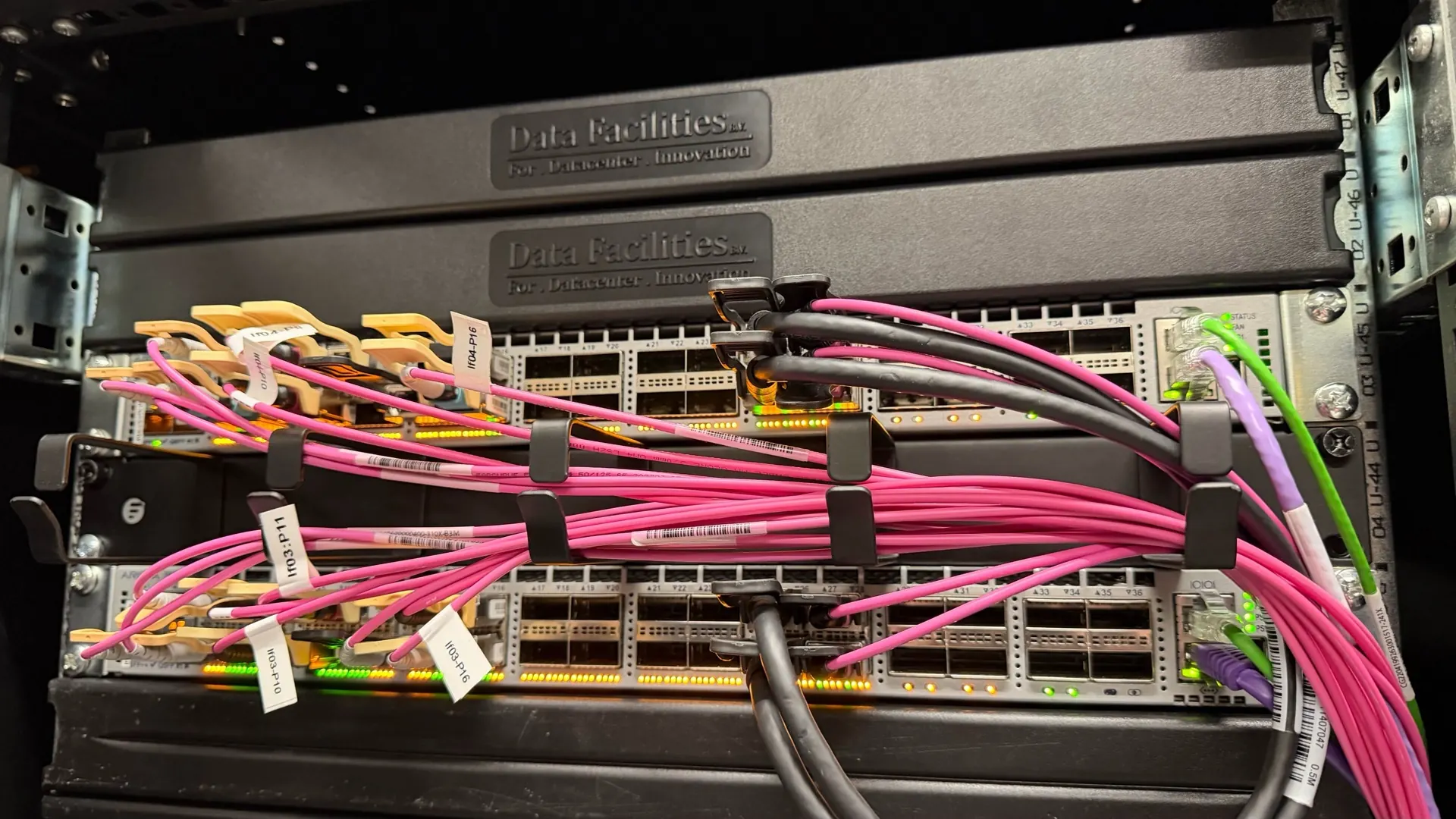
Every BareFABRIC Port ships with native DFIX peering and metro transport included — the same way, regardless of port speed or facility.
DFIX peering on every port from the moment it lights — open policy, RPKI-supported route servers, members set their own bilateral policy.
Layer-2 EVPN / VPLS between any two ports on the fabric, included at no extra cost. Provision a private VLAN to a remote site without ordering a separate metro circuit.
Two 10 G ports per THG1 tenant: one local, one at any other fabric facility. Included by default, not a launch promotion — written into the tenant contract.
Provision ports, configure VLANs, edit MAC entries, issue LOAs, enable RS sessions — all from a portal backed by an OpenAPI 3.1 surface.
BareFABRIC owns its own L2 / L3 equipment. Transport providers sell us L1 fiber and waves only — they do not sit between you and your customers, and we do not mark up their underlying capacity.
One service standard regardless of port speed. No gold or silver tiers, no 36-month lock-in — the same terms apply to a 10 G port and a 400 G one.
THG1 tenants get two free 10 G ports as part of their colocation. Public list price below.
| Port speed | THG1 tenant | Non-THG1 site | Optic |
|---|---|---|---|
| 10 G | Free (2 ports per tenant) | €75 / mo · €750 / yr | SFP+, single-mode |
| 100 G | €400 / mo · €4 000 / yr | €500 / mo · €5 000 / yr | QSFP28, single-mode |
| 400 G | On request | On request | QSFP-DD, single-mode |
A quarter cabinet at THG1 unlocks two free 10 G BareFABRIC Ports. From any other fabric facility, the same port is sold by the SKU above.
If you take colocation at THG1 — even a quarter cabinet — you get two free 10 G BareFABRIC Ports. One local, one at any other fabric facility. DFIX peering and metro transport included on both, permanently.
See colocationAt any of the 14 fabric facilities, anyone can buy 10 G, 100 G or 400 G BareFABRIC Ports — same SKU, same SLA, same portal. Same DFIX peering and metro transport included on every port.
Get a portAll six fabric products ride the same Arista EOS underlay and the same BareFABRIC Port. Layer them in the portal — no second hand-off.
The access SKU. 10 / 100 / 400 G. Two free 10 G for THG1 tenants.
See PortL2 EVPN / VPLS between any two ports. Included free on every port.
See MetroNative IX peering on every port. Open policy, RPKI route servers.
See DFIXIP transit on the fabric. Tier-1 upstreams + AMS-IX via our partner Netrouting (AS6206).
See TransitDark fiber across three carriers, redundant paths each. Pick the carrier that fits.
See FiberManaged waves on Nokia DWDM. 10 / 100 / 400 G end-to-end.
See WaveDFIP — the Data Facilities Interconnect Program — funds 36 months of space and power for qualifying networks. Standard tier: quarter cabinet, 1 kW. Premium tier: full rack, 5 kW for Tier-1 carriers. A structural investment in the density of the facility, not a promotional offer.


